The beginners guide to IPA for English Learners
Why does this word sound nothing like it’s spelled?
The International Phonetic Alphabet is a helpful tool to learn English pronunciation.
A few weeks ago, I was teaching a workshop on English vowel pronunciation, and we came to the comparison between two words:
“Fool” and “Full”
I asked the group of mostly French speakers to pronounce the two words. Most of them ended up saying words that sounded vaguely -- if not exactly -- the same.
When I gave them the correct pronunciation -- the long /u/ sound in fool versus the short /ʊ/ like in full--one student exclaimed that she had been calling herself a “fool” for so long, instead of saying that she was no longer hungry.
When it came time to make notes to remember that sound, many of them didn’t know how to write it. That /ʊ/ sound doesn’t exist in French, so it wasn’t something they knew to represent.
And that’s why they -- and you -- need IPA. And I’m not talking about the beer.
What is IPA?
Have you ever looked at a word in a different language and thought you knew how to pronounce it but had it totally wrong?
Same.
Many languages use the same letters but pronounce them totally differently (or inconsistently in the case of English) -- or use different symbols entirely. So, how do you know what the words are supposed to sound like?
That’s where IPA comes in. IPA is shorthand for the International Phonetic Alphabet, which creates a system of common symbols to represent sounds in different languages. So, if you know how to read IPA, you can pronounce a word in almost any language.
Why is IPA useful for English pronunciation?
If there’s one thing I say to clients all the time, it’s this: “English is dumb.”
Yes, French has many letters we don’t pronounce, BUT once you learn the spelling patterns, pronunciation stays roughly similar.
English -- on the other hand -- is not like that. For example…
There is one letter difference between the words “boot” and “book”, and yet they’re pronounced totally differently, as we’ll see later.
You see what I mean. English is dumb.
Not only that, there are sounds that don’t exist in other languages, like French. Going back to my workshop example, associating the IPA symbol with the new sound gave the participants a visual cue to remember the sound. When they come across that sound in the future and need a reminder, they’ll be able to use that symbol and know how to pronounce the word.
What a great tool!
But there’s so many IPA symbols. Do I need to know all of them?
If you’re already working on learning a language (and you are), being told you need to learn another different system of symbols to speak that first language is, well, annoying.
Here’s the good news. You don’t need to know all of them.
There are approximately 44 distinct phonetic sounds in English, separated into consonants and vowels.
Here’s even more good news. A lot of the phonetic sounds in English and French are the same. Which means you already know them. This means that you can concentrate on the sounds you don’t know. These will become your road map for successful pronouncing sounds that you’re learning.
The most important IPA symbols for English learners
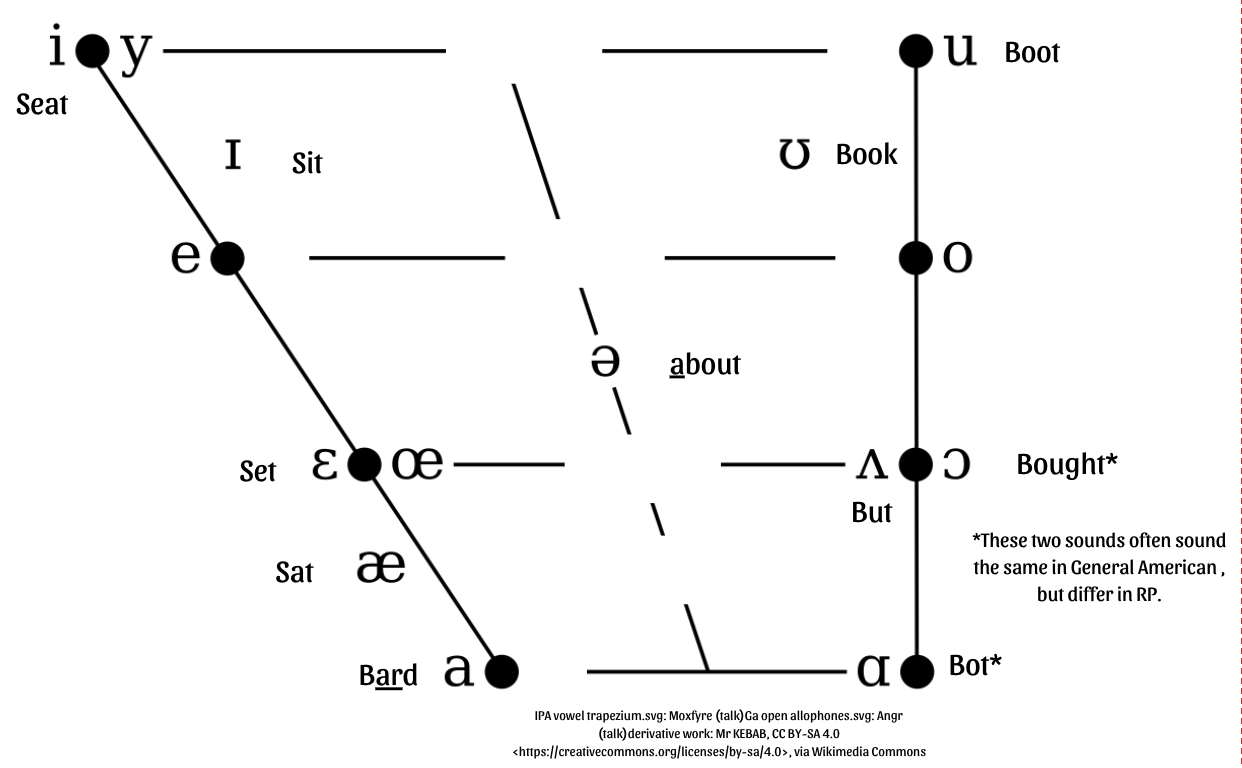
Now that you know you don’t need to learn all the IPA*, let’s focus on the ones you do -- starting with the vowels. While some of these sounds are sounds that exist in French, it’s important to know the IPA symbol to differentiate from sounds that don’t exist in French.
Here’s a table with some key vowel sounds to learn. These vowels are all monothongs composed of one sound. There are also diphthongs (two sounds), which we’ll explore in another post.
Vowel Sounds
Symbol Sample word
/i/ Seat /sit/
/ɪ/ Sit /sɪt/
/ɛ/ Set /sɛt/
/æ/ Sat /sæt/
/u/ Boot /but/
/ʊ/ Book /bʊk/
/ʌ/ But /bʌt/
/ɔ/ Bought /bɔt/
/ɑ/ Bot /bɑt/
/ə/ (schwa) Amuse /əmuz/
As far as consonants go, a lot of consonants are the same in French and English, but there are some key sounds that are helpful to get to know.
Consonant Sounds
Symbol Sample word
/θ/ (unvoiced) Thin /θIn/
/ð/ (voiced) That /ðæt/
/ʃ/ (unvoiced) Shoot /ʃut/
/ʧ/ (unvoiced) Chat //ʧæt/
/ʤ/ (voiced) Jog /ʤɔg/
/j/ You /ju/
*That said, if you’re feeling super motivated… you can learn all the IPA symbols and their sounds here.
How to practice with IPA
Even after you “know” the sound, there can often be a gap in knowing the symbol and being able to pronounce the sound correctly. It takes repetition to recognize the symbols so they become a helpful tool.
The first thing I have clients do is work on ear training, associating the symbol with the sound--especially for sounds that don’t exist in French and are similar to sounds that do.
Choose a set of tricky sounds, like our first example /u/ and /ʊ/, and listen to a recording of minimal pairs. This trains your ear to recognize the difference while associating it with the symbol.
Then, try repeating the sounds back and matching it. As you continue to train your pronunciation, you’ll be quickly able to associate the mouth shape with the symbol and sound.
IPA -- the tool to make English learning easy (or…easier)
Let’s go back to our workshop participants. Once they had the shorthand for the sounds, they were able to be more consistent in their pronunciation, and they mixed up the sounds less.
IPA can be intimidating, but rest assured that you don’t have to learn it all immediately to start speaking English more clearly. Start with a few symbols, and pretty soon it will become second nature.
Ready to dive in? Download my free IPA Vowel Quadrilateral to start training today.
